.png)
Tsering Namgyal Story
Name: Tsering “Guru” Namgyal
Age: 75
Home: Gulmarg Ski Resort
Birthplace: A small mountain village near Gulmarg
Nickname: “The Snowboard Guru” — earned, never claimed
Early Life (1950s–1960s)
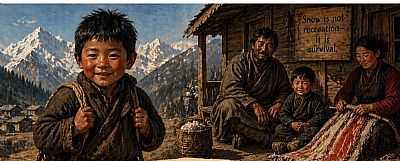
Tsering Namgyal was born in 1951, in a wooden house perched on the slopes overlooking the meadows that would later become famous as Gulmarg Ski Resort. His father was a shepherd who guided travellers through winter passes, and his mother wove thick woollen blankets to survive the brutal Himalayan winters.
Snow was not recreation—it was survival.
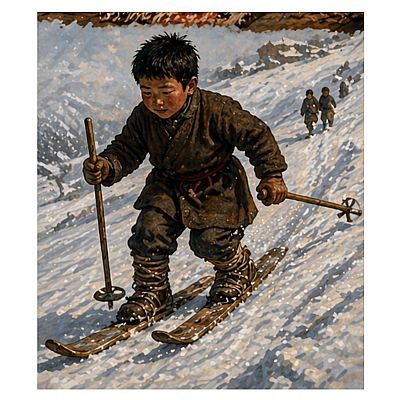
By the age of six, Tsering walked to school on wooden planks tied to his boots with rope—handmade skis built by his uncle from old walnut wood. He learned balance before he learned writing.
The Turning Point (1970s–1980s)
In his twenties, Gulmarg began attracting adventurous skiers from Europe. One winter in the late 1970s, a visiting rider arrived with something strange: a single wide board.
A snowboard.
Tsering watched from a distance for days before finally asking to try it. He fell endlessly—but unlike the tourists, he didn’t leave when the snow melted.
He carved his own board from deodar wood, sealing it with yak fat and pine resin. It was heavy, uneven, and dangerous—but it worked.
By the mid-1980s, locals began whispering that Tsering could ride terrain no one else dared—steep gullies, hidden bowls, and avalanche-prone slopes he seemed to read like scripture.
That’s when the nickname began.
Not a teacher.
Not a master.
Guru.
Europe Years — The Travelling Fixer (1990s)
In the early 1990s, Tsering followed seasonal workers to the Alps, eventually landing jobs in ski workshops across parts of France, Austria, and Switzerland.
At first, language was a problem.
But tools speak every language.
Soon, mechanics noticed his habits:
- Sitting cross-legged on benches
- Talking to boards like they were alive
- Smiling when others cursed broken edges
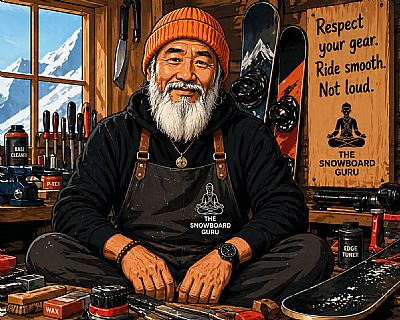
And always wearing an orange beanie, even indoors.
When asked why, he said:
“If you lose me in the workshop, look for the bright hat.”
The Meeting — Tara Winterhayez (2010s)
In the early 2010s, Tsering met Tara Winterhayez at a busy European workshop.
Tara had been repairing and waxing skis and snowboards since the 1970s—fast, precise, and known for immaculate finishes.
Their styles were completely different:
- Tara: Efficient, technical, exact
- Tsering: Patient, intuitive, methodical
At first, they disagreed about everything.
Wax temperatures.
Edge angles.
Storage methods.
But then something interesting happened.
They started sharing techniques.
Tsering taught Tara:
- How to read base damage like a story
- Why small imperfections matter
- How patience saves equipment
Tara taught Tsering:
- Modern waxing science
- Precision edge tuning
- Efficient workshop workflow
Together, they formed a kind of repair philosophy:
Take care of your kit, and it will take care of you.
The Philosophy — Helping Riders Ride Better
Over time, Tsering and Tara became known not just as repairers but teachers.
They believed most riders didn’t need better equipment.
They needed:
- Better maintenance
- Better habits
- Better understanding
Tsering’s famous line:
“A slow wax is faster than a fast rider.”
Tara’s reply:
“And a sharp edge beats confidence.”
Present Day — The Friendly Face of the Workshop
Now at 75, Tsering still works—but at his own pace.
He sits cross-legged while tuning boards, beard tucked into his jacket, orange beanie always on.
He laughs easily.
He tells stories.
And he always says the same thing when handing back a freshly tuned board:
“Ride smooth. Not loud.”